



Our morning meetings are going to feel a little quieter, and a lot less lively, without Bob Henning. For an incredible 53 years, Bob was the absolute heartbeat of the Wausau Morning Toastmasters Club #782. He earned his Advanced Toastmaster (ATM) designation and stepped up to serve in every single officer role the club had to offer.
On a personal note, Bob did the evaluation for my very first speech, 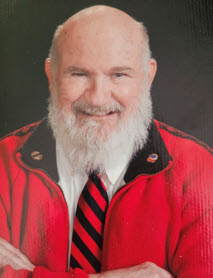 welcoming me with the exact mix of constructive feedback and warm
encouragement he was legendary for. We will deeply miss his booming voice, his endless supply of advice, and his presence at the podium. Bob passed away at the age of 83 on May 3, 2026.
As we honor the foundations Bob built for us over the last
half-century, our club is also stepping into an exciting new
chapter. Starting July 1, 2026, District 35 will officially transition
into District 212 as part of a wider Toastmasters International
realignment.
Change can be daunting, but this new designation brings wonderful opportunities:
- Fresh Energy & Connections: We will be grouped into newly aligned Areas and Divisions, opening the doors to fresh networking and collaborative events.
- Strengthened Support: The localized boundaries ensure each club gets optimized, targeted support from District leaders.
- A Renewal of Purpose: Just as Bob dedicated his life to helping the club evolve, this transition is the perfect moment for us to reinvest in our individual goals and welcome new members into the fold.
While our District number might be changing, our commitment to finding our voices remains exactly the same. Here’s to remembering our history and boldly stepping into District 212!
Here’s to the legacy that shaped us, and the new chapter ahead. We celebrate D35 and welcome in D212. Cheers!
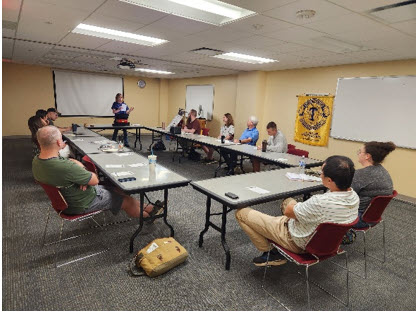
You’re invited; bring a friend! The La Crosse Toastmasters Club is hosting an 80th Anniversary Celebration on Saturday September 19, 2026 at the Black River Beach Neighborhood Center on La Crosse’s northside, 1433 Rose Street. Doors open at 2:00pm and refreshments will be served until 4:00pm. Because we meet on the second and fourth Tuesdays of the month, we also invite everyone to the following Open House on September 22 at 7:00pm in the basement of the La Crosse County Admin Center; enjoy free parking in the surface lot off 7th Street.
Keep a close eye on our club’s Facebook page for details and developments as the celebration planning begins in earnest. Members have been hard at work compiling into a timeline and display historical information from the La Crosse Public Library archives. As you know, Toastmasters’ learn-by-doing philosophy was created to help you gain the skills needed to achieve your personal and professional goals, while creating more confident communicators, public speakers, and leaders. We are proud to foster an incredibly welcoming and encouraging club environment in La Crosse.
 A Tribune article from April 1946, noted that twenty men from the Eau Claire Club visited the La Crosse YMCA to get the ball rolling locally. The La Crosse Toastmasters Club was officially chartered in September 1946 and celebrated with a banquet at the Stoddard Hotel. Situated at the southeast corner of 4th and State Streets in La Crosse, famous guests of the Stoddard have included Presidents John F. Kennedy and Richard Nixon, Elvis Presley, Frank Lloyd Wright, and Louis Armstrong. Over the years, notable members of the La Crosse Toastmasters Club have included Dr. Eric Gundersen and Professor Tom Thibodeau.
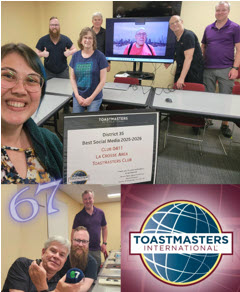
During District 35’s 2026 Spring Conference, our club received the best social media award. Please scroll through our Facebook page to see other candid moments from past meetings! You might even see the “67” photo collage. This is more than just a trend: it’s the setting on a thermostat or the age you hit retirement. Thank you to club member Daryl for all the fun memories his Humorous Contest speech gave us!
 Learn more about our shenanigans at www.facebook.com/lacrossetoastmasters.
Stevens Point, a town of a little over 25,000, is proud to have three Toastmaster clubs. What makes it unique in all of Toastmasters International, besides the fact of having three clubs in a relativity small community, is that all three clubs have been in existence for over 40 years.
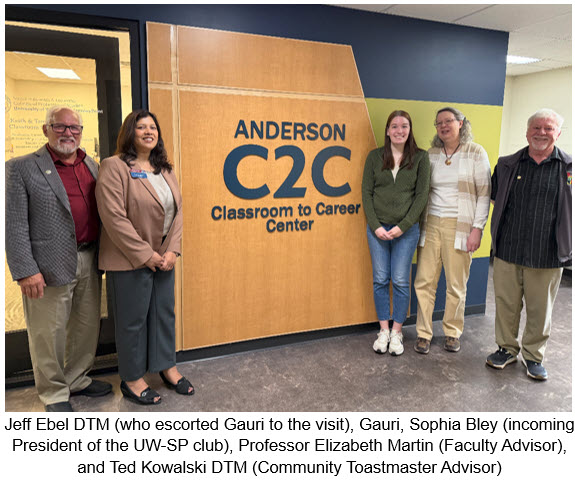
When Gauri Seshadri DTM, Toastmasters International First Vice President, visited District 35 for our Spring Conference, she made it a point to honor the community by visiting the three clubs.
Her first stop was a meeting with the President and CEO of Sentry Insurance, Pete McPartland. The Sentry Club #4596 was chartered in 1981. It is a hybrid club allowing the over 6,500 Sentry associates nationwide to benefit from the Toastmaster experience. It is open to community members as well. Pete has long been a champion of the club and attends at least one meeting every year.
Gauri’s second meeting was with members of the UW-SP University Toastmasters Club #6141. It was chartered in 1986 and recently celebrated its 40th Anniversary. University clubs are a challenge because of the short tenure of its members, but the club has been able to overcome that challenge for four decades. Strong leadership from local community Toastmasters and committed faculty advisors ensures the continued success of the club. It is now the third oldest University Toastmaster Club in all of Toastmasters International.
Gauri’s final stop was attending the meeting of the Stevens Point Toastmaster club #570 which was chartered in 1948. She served as a speech evaluator at the meeting and ended the meeting with a general question and answer session, inspiring those in attendance to continue their leadership track in Toastmasters.
Thanks to the strong Toastmaster leadership in Stevens Point, these three clubs will continue of offer communication and leadership development to residents of this special community in Central Wisconsin.
Let’s go, Speak-a-thon! On May 8, the night before the Spring Conference, DJAB and guests got together in Platteville. The club held a 10-speech gala, complete with a pizza bar and ice cream drinks. What a blast! Even some visitors from other clubs got in on the action by giving speeches of their own.
There were a whopping 25 people or so at the event, with at least half of the crowd being guests or former members that DJAB is trying to entice back into the fold. DJAB even managed to score some new members during the fun, and there was a sign-up list for people interested in hearing more about the club.
DJAB knows how to turn a rollicking party into a membership event!
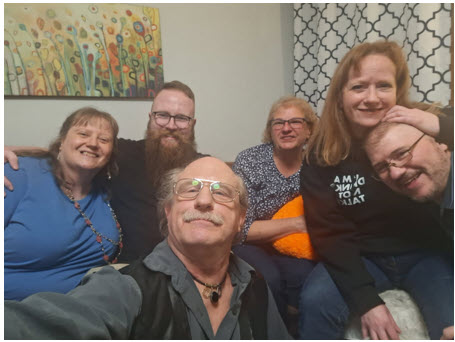 A few of the people at the after-Speak-a-Thon party, plus Carl, the sheep/yak
For me, Toastmasters has transformed everyday challenges into meaningful achievements, especially when it comes to communication, confidence, and adaptability.
One of the most notable impacts has been the ability to think and act quickly. For example, I successfully created and delivered within just a few hours on the same day, a presentation about myself. What once might have felt overwhelming became a chance to step up with confidence, organize my thoughts, and deliver a clear message. Toastmasters sharpened more than just speaking skills. It built the confidence to organize thoughts quickly, craft a clear message, and deliver it with purpose, no matter what the timeframe.
 This growth has extended into larger settings as well. I’ve become more comfortable introducing myself to both small and large groups, sharing my background and experience in a professional and engaging way. A standout moment was delivering under several challenges a 30-minute PowerPoint presentation to my teammates. Those challenges included a new location, unfamiliar computer setup, unexpectedly presenting first instead of second, and even a last-minute slide change. Despite these variables, and with the help of some members of the audience who had deep knowledge of the topic, the presentation went smoothly. In the past, any one of these could spark anxiety. Combined, they could feel overwhelming. But thanks to Toastmasters, the result was a confident, composed presentation that captivated the audience.
The thoughtful questions during and after showed strong engagement and genuine interest in learning more.
Beyond individual growth, the club itself continues to create impactful experiences. On April 13, 2026, the Credit Union Toastmasters Club hosted its first Open House. Club members promoted the event through the company intranet and set up a table in a high-traffic cafeteria area, handing out flyers to build awareness of the Open House meeting.
The Open House welcomed four in-person visitors and one virtual attendee from California, marking the club’s first hybrid meeting after COVID. The momentum continued, as additional employees attended the next meeting after seeing the intranet promotion; several expressed strong interest in joining after experiencing the value firsthand.
Toastmasters is more than a club, it’s a launchpad. It turns hesitation into confidence, preparation into performance, and everyday professionals into compelling communicators.
From last-minute presentations to leading conversations in any room, the growth is real. Whether presenting on short notice or engaging in a room full of peers, the skills gained continue to make a lasting impact.
OK, so during your Area Director’s visit to your club, he/she mentioned that your club has met a certain number of goals. What does that mean exactly? Why is it so important to earn that Distinguished designation?
To each club, it may mean something different. Ultimately though, becoming a Distinguished Club is an exciting accomplishment as your members are pulling together for common goal. Per Toastmasters International, the Distinguished Club Program recognizes achievements in education, membership growth, club leadership, and club communication each year. It is a general measure of club success, and some can say health.
This program encourages the club to not only help its members accomplish its goals but also adhere to the club mission statement and measure members’ progress with the targets set in the Club Success Plan periodically.
My club, Guardian Toastmasters, was no different. During the Club Success Plan phase this year, our Secretary Carol challenged us all, asking: “Why can’t we become Distinguished this year?” To preface this question, our club had never done a Club Success Plan, and we were barely at eight renewing members. That question turned out to be a game changer.
September came around, and we submitted our Club Success Plan. Our members began committing to completing their projects. One Level 5…Check! Two Level 2s…Check!
Expanding on that, we submitted our dues renewals, and our officers attended the TLI training sessions, including a few who attended multiple sessions.
Next came membership. We thought we could commit to welcoming two new members for the year in our Club Success Plan. Then, we looked at our goals. We needed at least four new members. Our steadfast Secretary declared, “Why not set the bar higher? Onboarding four members versus two is not that different.”
We addressed this goal head on from multiple fronts. Open invitations to our monthly coffee chats. Publicizing on our internal social media. ‘Bring a friend campaigns. Lastly, we made a big to-do about our Open Houses. All told, we have onboarded five new members, and we are still actively recruiting!
OK, five goals down. We just need to net one more member. Whether we make it to Distinguished or not is not the end all. Looking back at what we did this year with pride is the true measure of success.
Here’s hoping your club can ask the same question: “Why can’t we be Distinguished?”
A recent article stimulated these shared thoughts, which will be the topic of a prepared speech at my club, Stevens Point Toastmasters, sometime soon. While now retired from a professional career that had me writing news releases, magazine articles, photo cutlines, and member relations letters, I was often sensitive to the correct spelling of names and necessary details. But never did I consider that the business of writing might be AUDIO FIRST!
Are you an avid book reader? How about listening to podcasts and audiobooks? Do you listen to speeches? (Obvious question for a Toastmasters audience!) Do you think the speech draft was written, practiced, and then delivered with the two organs on either side of your head, as top of mind?
Sadly, my own answer would be “NO!” The ideas shared here may create a new consciousness as you prepare your next speech. Consider shaving off a word here and there to help pick up the pace, to make listening easier and smoother. That sort of change shouldn’t hold you back behind the delay tactic we sometimes hear, “It’s not quite ready yet.”
As Toastmasters, we encourage each other to drop filler words and use the power of the pause to let our key points sink in. Listeners are more imaginatively engaged when we don’t over-explain or describe.
Storytelling is often already “ear friendly.” This comes from the ancient art of performance; spoken word effects are embedded in most writers’ voices intuitively. But how might we prioritize a rhythmic flow of words to make them flow musically? How ‘performable’ is your speech copy?
The difference in hearing speeches is that you only get to listen once; what’s said flashes by and is gone. In reading a book and even listening to audiobooks, you can go back and re-read the paragraph or passage, or rewind and hear it again. But a conscious effort to make your speech flow, all the while embodying vocal variety, pace, volume, and tone, may contribute mightily to being remembered… or not!
It likely will come down to PERFORMANCE. Read your draft aloud. You may be surprised by how, after hearing it, you readily flush things sounding strained, overwritten, or what makes you stumble as you find yourself out of breath, unable to complete the thought.
I hope I’ve raised your consciousness and attention to your word choices in your next speech draft. Happy writing for the ear!
Thank You To All D35 Edge Article Contributors
by Susan Brushafer, D35 Edge Newsletter Article Collector
 You know who you are, and it would be difficult for me to thank each of you individually. Over the years that I have been the ‘article collector’ for the D35 Edge Newsletter, you have responded with timeliness. You’ve shared your personal and club achievements. You’ve shared ideas for creative Table Topics, outstanding Open Houses, and fun after-meeting and in-addition-to-meeting events. Your articles included pictures that put smiles on our faces! Many articles motivated us by the ways in which Toastmasters has enhanced your communication skills and boosted your self-confidence. You’ve shared with us your personal journeys, businesses you’ve started or grew in, and even the books you’ve written. Just as we are grateful to District 35 for the way it has cared for its members over these years, I’m grateful to each of you who shared your and your clubs’ successes and challenges.
PS The above article came in at 137 words. 😇

2025-2026 Fourth Quarter Triple Crown Awards
| Anna Poplawska | Reedsburg Area Club |
| Jason Feucht | NM Speaks |
| Jim Kohli | Love of Laughter |
| Lakesha Davis | COMPASS Toast Team |
| Matt Wuteska | ROK the Talk |
| Michael Zelm | Capital City Club |
| Sarah Knappman | GE Speaks Toastmasters Club |
| Timothy Bailey | Ozaukee Toastmasters |